
 +380675119928
Natural Leather for Harness: How to Choose the Material
When a craftsman or designer plans to create a leather harness, the initial focus often lands on superficial choices: the color palette, the strap width, or the visual style of the hardware. However, a genuinely high-quality, durable harness never begins with the buckle or the shape of the pattern. It begins with structurally sound, correctly selected leather. The material itself dictates whether the final product will retain its precise lines over time, how it will behave across complex body contours and sharp bends, whether it will stretch unevenly under stress, or whether unsightly, coarse creases will ruin its aesthetic value. Furthermore, the edge presentation and how cleanly the holes age depend directly on the structural characteristics of the hide.
At V-Center, we approach natural leather from the perspective of real industrial manufacturing rather than abstract marketing descriptions. Consequently, we clearly distinguish between leather that looks pleasing on a retail shelf and leather that excels structurally when transformed into a functional or fashion harness. A harness is fundamentally different from a standard wallet or a soft, slouchy bag. It is subjected to distinct biomechanical loads, demands a unique pattern cutting logic, and possesses a completely different operational character. For a harness to look premium and feel comfortable, the leather must be sufficiently dense to maintain sharp, straight lines, yet compliant enough to avoid looking bulky, rigid, or detached from the wearer’s body.
If a leather artisan uses a material that is too soft or spongy, the harness will inevitably begin to «sag» and lose its clean lines, particularly across long shoulder straps and around high-stress hardware attachments. Conversely, selecting excessively rigid or stiff technical leather yields an equally problematic result: the harness becomes uncomfortable to wear, fails to contour naturally to the human body, and creates a bulky, clumsy silhouette that deviates from the intended design. Superior leather for harness production always represents a calculated equilibrium between structural form retention, density, and workable plasticity.
What Kind of Leather Harnesses Are Made From
Most high-end harnesses are manufactured using natural leather derived from bovine hides (cattle hides, specifically heifer or bull leather). This specific raw material source inherently yields the optimal synthesis of tensile strength, dimensional stability, and functional structural plasticity. It is perfectly matched for strap-based configurations because it resists distortion under continuous load, handles directional tension properly, and retains its physical geometry in areas subjected to constant movement and friction.
To put it simply, leather intended for harness production must behave like premium-grade strap material. It must possess zero «sponginess,» resist easy stretching, and never feel like an accidental or compromised choice in the finished piece. Simultaneously, it is critical that the material is not dry or brittle. Brittle tendencies are easily spotted right at the cutting table: while a properly tanned hide handles crisp hole punching, edge beveling, and hardware setting effortlessly, an unstable or overly dry hide reveals its poor quality from the very first cut.
The surface characteristics are equally vital. In a harness, every square centimeter is exposed to scrutiny: the grain surface, the beveled edges, the punched holes, and the hardware attachment junctions. Therefore, the selected leather must not only be structurally dense but also exceptionally clean and neat, enabling precision cutting and seamless edge finishing.
What Leather Is Suitable for a Harness
The ideal leather for high-quality harness wear must combine deep structural density, dimensional stability, and calculated elasticity. Structural density is mandatory to ensure that the individual straps maintain a crisp, clean aesthetic instead of collapsing. Dimensional stability guarantees that the accessory will not stretch out of shape, distorting its symmetry after a few weeks of wear. Finally, balanced elasticity prevents the grain from cracking at tight bends or behaving too aggressively against the body.
In a hands-on manufacturing environment, high-quality harness leather proves its worth immediately upon handling. It should feel firm and supportive, without mimicking the unyielding stiffness of heavy industrial machinery belting. When you bend the correct type of leather, it should show controlled, smooth resistance, rather than collapsing into sharp, unsightly wrinkles or cracks. When subjected to directional tension, the strap must stand firm rather than stretching out like a textile ribbon.
A harness is an unforgiving accessory when it comes to material selection; mistakes and compromises show up almost immediately. While a bag or backpack design can conceal minor material flaws through structural lining, internal reinforcement, or volumetric shapes, a harness exposes everything. For this reason, professional leather workers select their material based on specific engineering requirements and model types rather than superficial preferences.
What Thickness Works Best for a Harness
One of the questions we encounter most frequently at V-Center is regarding the ideal thickness for harness production. There is no single, universal measurement for all designs, as the perfect thickness is contingent upon the structural complexity and intended use of the accessory. A delicate, highly decorative women’s fashion harness and a more robust, heavily accessorized structural harness demand different material characteristics, even if they look somewhat similar in a sketch.
Using leather that is too thin is a guaranteed path to production failure. While thin leather may seem easy to cut and manipulate initially, the finished straps quickly lose their crisp edges during wear. They become overly soft, collapse under the weight of the hardware, and destroy the clean, graphic silhouette that makes a harness visually compelling. On the other hand, utilizing overly thick leather introduces a different set of problems: the accessory looks unnecessarily industrial, fails to wrap smoothly around body contours, and becomes highly difficult to adjust through buckles and sliders.
The ideal sweet spot lies within a carefully calibrated middle tier. To use a simple comparison, a premium harness should sit on the body like a luxury, high-end strap accessory—supple yet perfectly structured—rather than feeling like a flimsy decorative ribbon or a rigid piece of heavy industrial equipment.
What Works Better for a Women’s Harness
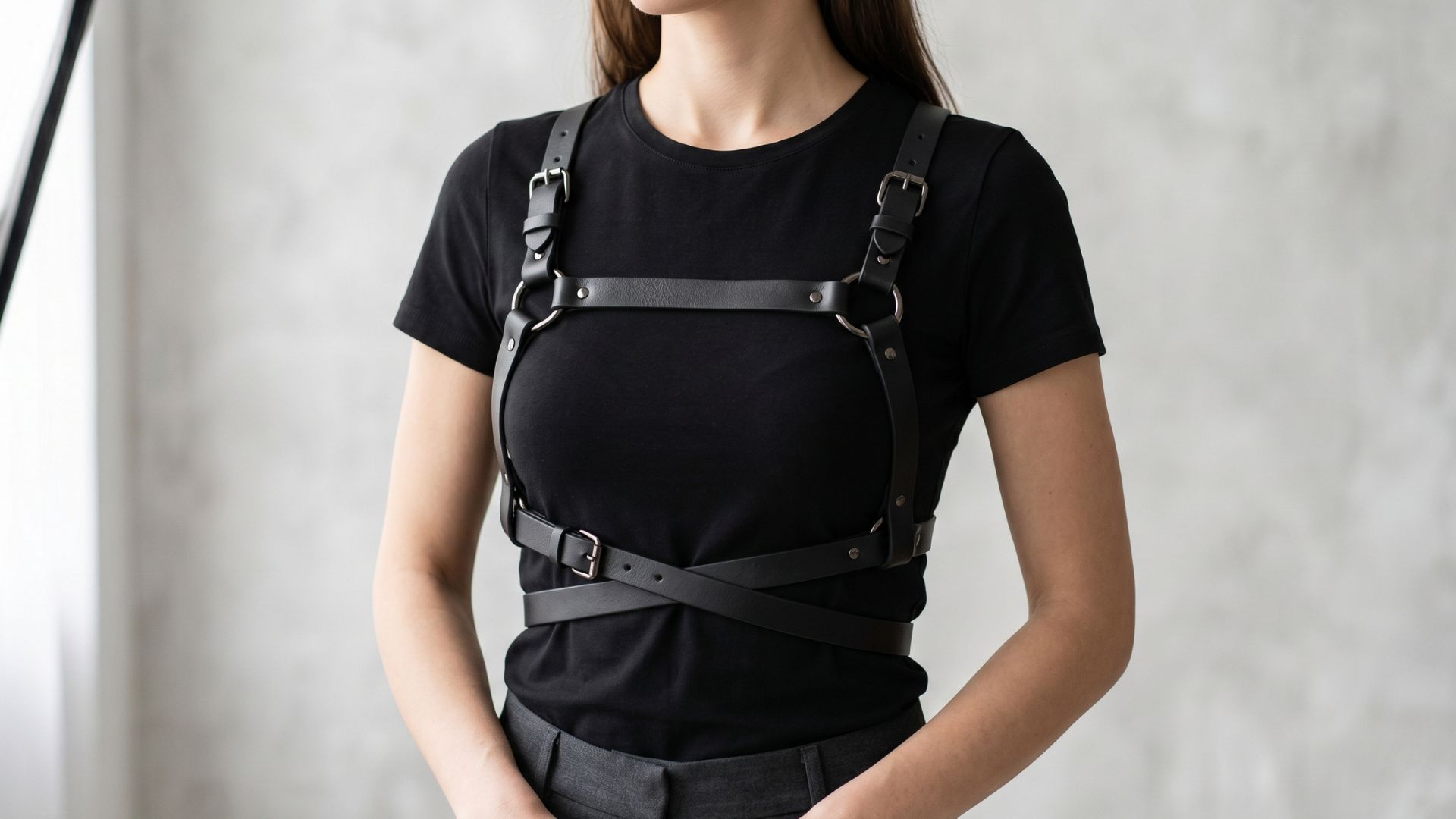
Designing and manufacturing a women’s harness demands an elevated level of attention regarding material behavior. Here, the challenge is to deliver robust structural integrity without sacrificing elegant plasticity. The leather must perform flawlessly when cut into narrow, delicate lines, ensuring it does not add unwanted visual weight or create an uncomfortable, rigid fit.
A frequent error among manufacturers is selecting a heavy, unyielding belt leather and attempting to split or cut it down to build a delicate women’s fashion piece. This approach invariably leads to an accessory that feels heavy, stands awkwardly away from the natural curves of the body, and completely misses the refined, sophisticated look that the designer intended.
For female fashion silhouettes, it is best to choose a leather that holds a crisp edge while remaining completely responsive to movement. This requirement is especially critical across the shoulder straps, lateral bust lines, and adjustable closure points, where the material must look impeccable while adapting naturally to the body's movements.
What Material Works Better for Decorative and Fashion Harnesses
When the primary objective shifts away from heavy functional utility toward the realm of decorative runway fashion and avant-garde style, the visual properties of the leather take center stage. The way the grain interacts with light, the uniformity of the surface texture, the neatness of the cut edge, and how seamlessly the material complements premium metal hardware become the driving factors of quality.
However, even for strictly decorative designs, settling for sub-standard or random leather is a major misstep. A fashion harness remains, fundamentally, an assembly of interconnected straps. If the leather lacks structural memory, the lines will twist, the edges will curl, and the premium appeal of the design will be entirely lost. Conversely, if the leather features an overly synthetic, heavy plastic coating, it loses its premium natural texture and looks cheap.
For high-fashion applications, the smartest choice is specialized leather that offers an immaculate surface finish, perfectly uniform thickness across the entire hide, and clean behavior when beveled and burnished. These specific structural properties elevate even the simplest harness designs into luxury-grade items.
What to Look At Besides Thickness
While thickness is a core metric, it cannot be evaluated in isolation. For high-end harness production, you must analyze how the leather behaves under mechanical manipulation: specifically, how cleanly it accommodates hole punchers, and how it holds rivets, heavy snaps, metal rings, and adjustment buckles. If the internal fiber structure of the hide lacks density, punched holes will quickly warp into ovals under tension, and the hardware mounting areas will look worn and distorted before the product even leaves the workshop.
The resilience of the surface finish is equally important. If the top coat is fragile, the friction of metal buckles and rings will scar and scratch the leather during assembly or initial fittings. If the finish is overly sealed with cheap films, the natural essence of the material is lost. Lastly, pay close attention to the edge or «flesh cut» (urez). On a harness, the cut edge is a defining visual feature. The leather must allow for smooth edge finishing, without fraying, splitting, or showing a loose, fibrous interior.
V-Center Assortment of Natural Leather for Harnesses and Strap-Based Products
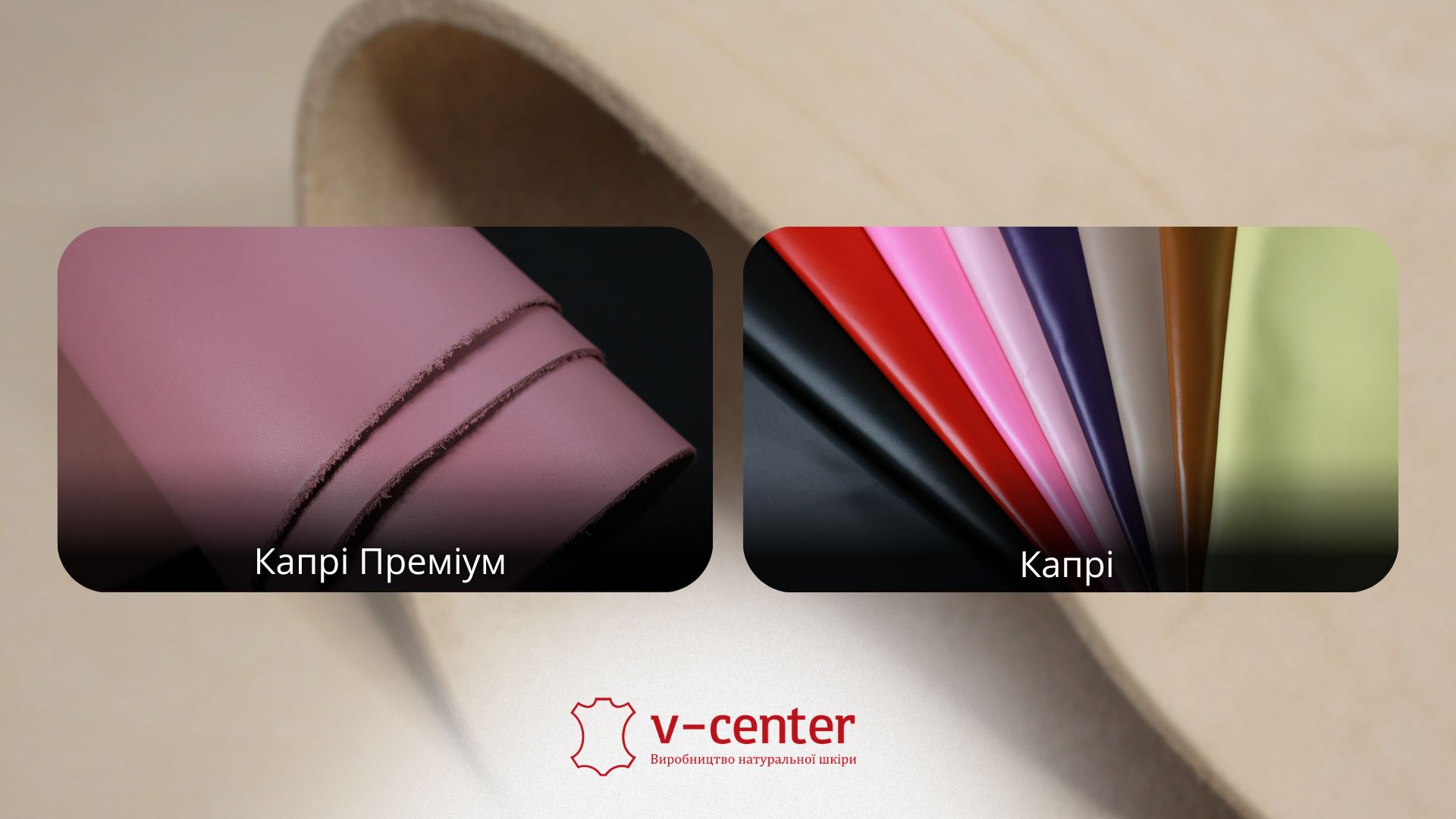
To satisfy the rigorous technical demands of luxury accessory designers and industrial leather goods manufacturers, V-Center has developed a specialized line of premium leather goods material under the Capri family. These professional-grade articles are engineered specifically to provide impeccable strap geometry, superior dimensional stability under continuous tension, and a flawless cosmetic presentation on both the face and reverse sides. By offering distinct finishing options, we allow creators to precisely match the material to their specific production needs.
Capri
The standard Capri article represents a benchmark high-performance natural leather optimized for a wide spectrum of premium leather goods and strap accessories. It is the premier choice for harness designs where a clean, uniform grain surface, excellent cutting yield, high density, and sharp, graphic strap lines are paramount.
Technical Requirements and Characteristics of the Capri Article:
- Recommended Intended Use: For fine leather goods (belts, harnesses, bespoke accessories).
- Type of Raw Material: Selected bovine hides (heifer or bull leather).
- Configuration: Half hides, premium bends.
- Thickness Options, mm: 1.2–1.4; 1.3–1.5; 1.4–1.6.
- Color Range: Deep black, curated fashion colors.
- Method and Character of Finish: Leather with a buffed grain surface treated with a premium emulsion finish and subtle, dust-like micro-embossing. This leather is highly dense, stable, and exceptionally durable. The gloss and luster level can be custom-adjusted based on wholesale volume requirements.
Physico-Mechanical Properties and Chemical Composition of Capri Leather:
| Parameter Description | Technical Requirements (Per Batch) |
|---|---|
| Tensile strength, 10 MPa, minimum | 1.1 |
| Stress at the appearance of grain cracks, 10 MPa, minimum | 1.0 |
| Elongation under 10 MPa tension, % range | 30–50 |
| Coating resistance to wet rubbing, minimum cycles | 80 |
| Coating resistance to repeated flexing, minimum score (points) | 4 |
| Color fastness of leather to dry rubbing, minimum score (points) | 5 |
| Color fastness of leather to wet rubbing, minimum score (points) | 4 |
| Moisture mass fraction, % | 10–16 |
| Chromium oxide mass fraction, %, minimum | 3.5 |
| Additional Metrics: Mass fraction of substances extractable by organic solvents, % | 3.7–10 |
Capri Premium
Capri Premium is an advanced, highly specialized evolution of our core leather goods material, engineered for unlined luxury accessories. The distinguishing feature of this article is its comprehensive double-sided emulsion treatment. This advanced process eliminates the raw, fuzzy look of the reverse side (flesh side/bakhtarma), turning it into a smooth, visually stunning surface that mirrors the premium quality of the grain side.
Technical Requirements and Characteristics of the Capri Premium Article:
- Recommended Intended Use: Luxury leather goods, unlined designer harnesses, high-fashion body accessories.
- Type of Raw Material: Selected bovine hides (heifer or bull leather).
- Configuration: Half hides, premium bends.
- Thickness Options, mm: 1.2–1.4; 1.3–1.5; 1.4–1.6.
- Color Range: Deep black, rich fashion colors.
- Method and Character of Finish: Dual-surface processing featuring a corrected grain face and a fully finished, slicked flesh side (bakhtarma). Both sides receive a synchronized emulsion treatment and elegant dust-like micro-embossing. It is incredibly stable during cutting, highly dense, and resists fiber shedding. Gloss level customizable upon request.
Physico-Mechanical Properties and Chemical Composition of Capri Premium Leather:
| Parameter Description | Technical Requirements (Per Batch) |
|---|---|
| Tensile strength, 10 MPa, minimum | 1.1 |
| Stress at the appearance of grain cracks, 10 MPa, minimum | 1.0 |
| Elongation under 10 MPa tension, % range | 20–50 |
| Coating resistance to wet rubbing, minimum cycles | 80 |
| Coating resistance to repeated flexing, minimum score (points) | 4 |
| Color fastness of leather to dry rubbing, minimum score (points) | 5 |
| Color fastness of leather to wet rubbing, minimum score (points) | 4 |
| Moisture mass fraction, % | 10–16 |
| Chromium oxide mass fraction, %, minimum | 3.5 |
| Additional Metrics: Mass fraction of substances extractable by organic solvents, % | 3.7–10 |
What Works Best for a Harness
When selecting between these two professional-grade articles for harness manufacturing, the technical decision framework is clear and straightforward:
- Capri is perfectly engineered for classic strap accessories where the reverse side of the leather is lined, stitched down, or where the design purposefully permits a clean, natural buffed flesh side. With a standardized elongation range of 30–50% under tension, it offers excellent initial flexibility, making it highly accommodating for intricate assembly techniques and precise manual molding.
- Capri Premium is the definitive, no-compromise choice for luxury, high-fashion, and unlined body harnesses. Because both the face and the flesh sides are fully sealed with a professional emulsion finish, the straps look completely flawless from every angle. This dual-sided processing completely prevents the flesh fibers from fuzzing or pilling over time, safeguarding the wearer's delicate garments from friction. Furthermore, its tighter, reduced elongation profile (20–50%) ensures maximum structural resistance against directional stretching. Long shoulder straps and waist belts retain their original tailored dimensions, and punched holes remain pristine without oval distortion, even under daily usage conditions.
A Practical Approach to Choosing Leather
Expert leather selection requires matching a material's technical parameters with the exact physical mechanics of your design. Factors such as strap width, the concentration of heavy hardware accents, and the type of edge treatment (edge painting vs. edge slicking) should dictate your final choice. At V-Center, we provide our clients with clear, data-backed material specifications so that your choice translates into production efficiency and long-term product durability.
Where to Buy Leather for Harnesses in Ukraine
If your manufacturing facility or design studio requires premium-grade natural leather for harness production in Ukraine, sourcing directly from a dedicated manufacturer is the most efficient choice. This eliminates material inconsistency and secures stable wholesale pricing. V-Center provides specialized leather lots engineered specifically for high-end strap accessories and body harnesses.
Whether you are prototyping a delicate women’s fashion collection or manufacturing high-volume structural strap systems, our team provides expert material matching based on thickness, surface character, and batch uniformity.
Sourcing & Contact Details
To request customized hide selections, review full swatches, or establish a wholesale manufacturing supply contract, please connect directly with our sales team:
- Svitlana: +380675119928
- Viktoriia: +380675143576
- vcenter.official@gmail.com
FAQ
What leather is best for manufacturing a harness?
The ideal material is dense bovine leather (heifer or bull hides) featuring a uniform thickness, high tensile strength, and low elongation metrics, such as our specialized Capri and Capri Premium articles.
What kind of leather are harnesses typically made from?
They are made from premium-grade bovine (cattle) hides because their grain structure provides the optimal balance of structural memory, edge-burnishing capability, and resistance to deformation under load.
What leather thickness is recommended for a harness?
Thickness should align with design intent. For fine fashion lines and delicate women’s harnesses, 1.2–1.4 mm or 1.3–1.5 mm is optimal. For heavier, highly structured, or load-bearing strap systems, we recommend 1.4–1.6 mm.
Can a high-quality harness be crafted from soft garment leather?
No. Excessively soft or loose-grain garment leather lacks structural integrity. Under the weight of metal hardware and natural body movement, soft leather straps will stretch unevenly, warp around punched holes, twist along their edges, and lose their crisp graphic lines.
What leather article works best for delicate women’s fashion harnesses?
Our Capri series is ideal because it allows the straps to be cut into narrow widths while maintaining perfect edge geometry and comfortable flexibility without feeling rigid or heavy.
What material should be chosen for avant-garde and runway fashion harnesses?
Capri Premium is highly recommended. Its dual-sided emulsion finish guarantees that the interior of the harness looks as luxurious and polished as the exterior, ensuring an impeccable aesthetic on the runway or in retail displays.
What is the exact structural difference between the flesh side of Capri and Capri Premium?
The standard Capri article features a clean, uniform, natural buffed flesh side (bakhtarma). The Capri Premium article undergoes an advanced, dual-surface mechanical and chemical treatment where the flesh side is completely flattened, sealed, and finished with an emulsion coating, completely matching the grain face in color and durability.
Does the elongation index of Capri leather prevent long straps from sagging over time?
Yes. Capri Premium is engineered with a strict 20–50% elongation threshold under a 10 MPa load. This structural stability minimizes the long-term stretching of shoulder and waist straps, keeping the harness perfectly tailored to the wearer's silhouette.
Will the finished coating of Capri leather transfer color or stain light-colored clothing?
Absolutely not. According to strict technical requirements, Capri leather possesses an exceptionally high color fastness score (a rating of 5 for dry rubbing and 4 for wet rubbing, along with a wet rub coating resistance of at least 80 cycles). This industrial-grade sealing guarantees that the leather will not bleed or transfer pigment onto garments during daily wear.
How does Capri leather react to mechanical hole punching and heavy hardware setting?
Due to an excellent tensile strength rating (minimum 1.1 per batch) and high internal fiber density, the leather yields perfectly clean, crisp holes that do not fray or stretch out into oval shapes under the mechanical compression of rivets, holnitens, or heavy buckles.
Can the gloss level of Capri leather be customized for large manufacturing orders?
Yes. V-Center can adjust the top-coat formulation to deliver a matte, satin, or high-gloss finish to match the specific stylistic identity of your accessory brand, provided wholesale batch minimums are met.
Where can I purchase genuine V-Center Capri leather for harnesses within Ukraine?
You can buy authentic Capri and Capri Premium leather directly from our manufacturing facilities in Ukraine by reaching out directly to our official sales department via phone or email for custom batch fulfillment.